
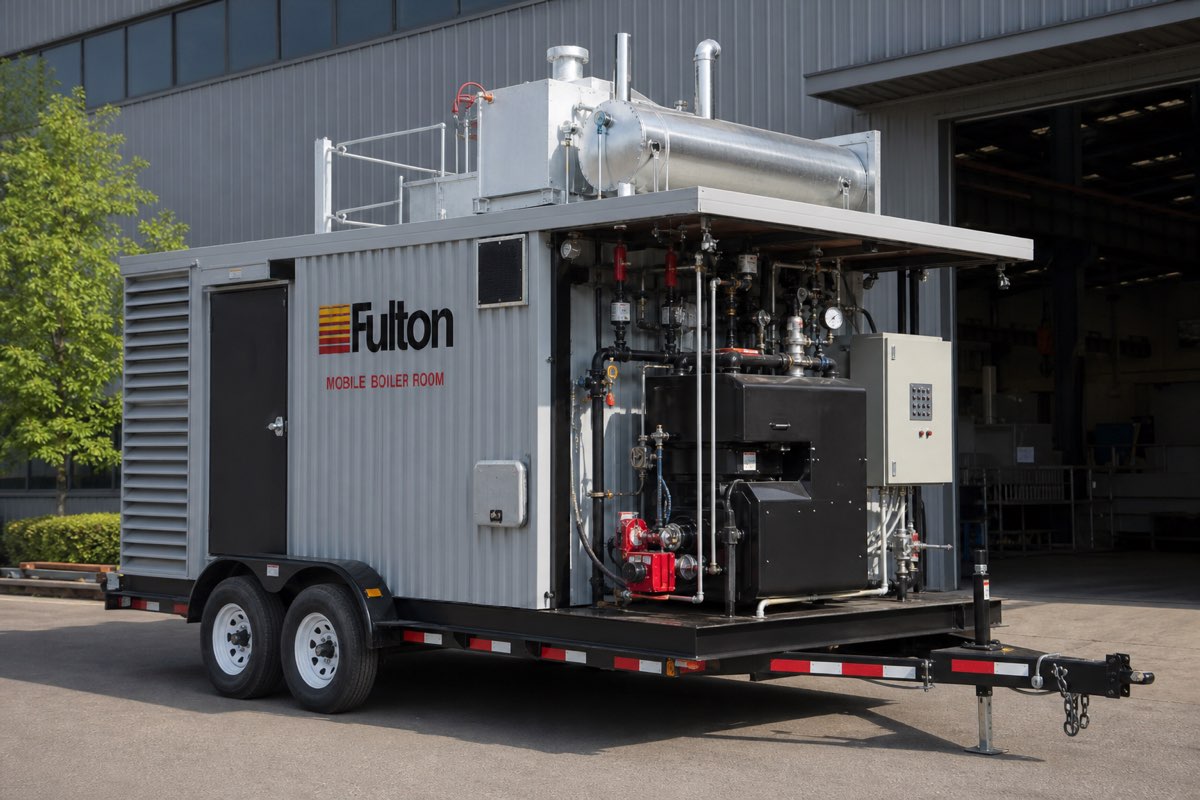
Emergency boiler rental
When a boiler fails without warning, lost heat, lost process steam, or lost sterilization becomes an operating problem by the hour. We route emergency boiler rental requests to vetted providers carrying temporary units, so a facility manager describes the failure once and that request reaches several qualified yards at the same time. Response times vary by location and provider availability, which is exactly why a request goes to multiple providers rather than a single source.
By Industrial Rental Co Editorial Team Reviewed July 2026
- Unplanned failures: lost heat, process steam, sterilization, or hot water
- One request routed to several vetted providers at once
- Firetube and watertube units across a wide capacity range
- Insurance-verified providers carrying ASME-coded equipment
One request reaches several qualified providers
In an outage, the slowest part of finding a rental is usually the search itself: calling yards one at a time, repeating the same specs, and waiting for callbacks. The matching model removes that step. You submit the failure details and required capacity once, and the request routes to multiple vetted providers who carry temporary boilers, so quotes come back in parallel rather than one phone call at a time.
Because availability, freight distance, and rigging all vary by region, no single provider can promise a unit for every situation. Routing to several at once raises the odds that one of them has a suitable unit positioned near you and ready to mobilize. We do not own equipment or dispatch trucks; we connect your request to the providers most likely to fulfill it.
- Describe the failure and capacity once, reach several providers
- Quotes return in parallel instead of sequential phone calls
- Providers self-select based on stock, distance, and fuel match
- No owned inventory: requests route to independent rental yards
The spec details that get you an accurate quote fastest
The fastest emergency match comes from a clear spec, even a rough one. Providers need to know capacity, expressed in boiler horsepower (BHP) or pounds of steam per hour for steam, or BTU per hour for hot water, along with operating pressure, the fuel available at your site, and where the temporary unit will tie in. A flooded boiler room and a cracked tube sheet can need very different units, so the more you can describe the failure, the better the match.
If you do not have every number, send what you have. Nameplate data from the failed boiler, a photo of the existing connection point, and the fuel at the curb are often enough for a provider to scope a starting unit. Sharing utility constraints early, such as available gas pressure and electrical capacity, prevents a unit that fires at full rate on paper but cannot deliver it at your site.
- Capacity in BHP or lbs/hr for steam, or BTU/hr for hot water
- Operating pressure and whether the load is steam or hot water
- Fuel available on site: natural gas, propane, or diesel
- Connection point, tie-in location, and any utility limits
Facilities where a boiler outage stops everything
Some buildings treat a boiler as life-safety or core process, not a convenience. Hospitals and surgical centers rely on steam for sterilization and on heat and domestic hot water for patient areas, so an outage is a clinical problem, not just a comfort one. Multifamily housing loses tenant heat and hot water the moment a central boiler drops, which in cold weather becomes a habitability and code issue quickly.
Food and beverage processing depends on steam for cooking, cleaning, and sanitation, and a lost boiler can idle a whole line and put product at risk. Manufacturing plants that use process steam or heat for curing, drying, or jacketed vessels lose throughput by the hour. For all of these, a temporary boiler is the bridge that holds the load until the permanent unit is repaired or replaced.
- Hospitals: sterilization, patient heat, and domestic hot water
- Multifamily housing: tenant heat and hot water, habitability rules
- Food and beverage: cooking, cleaning, and sanitation steam
- Manufacturing: process steam and heat for production lines
Common questions
How fast can an emergency rental boiler be on site?
It depends on unit size, fuel, freight distance, and which providers have suitable equipment available, so response times vary by location and provider availability. A small trailer-mounted unit near a stocked yard mobilizes faster than a large package that needs rigging and permits. Because timing cannot be promised against a fixed window, your request routes to multiple qualified providers at once to improve the odds of a nearby unit. The clearer your spec, the faster a provider can confirm a match.
What information should I have ready for an emergency boiler request?
Capacity is the most important: boiler horsepower or pounds of steam per hour for steam, or BTU per hour for hot water. After that, providers need operating pressure, the fuel available at your site, and the connection or tie-in point. Nameplate data from the failed boiler and a photo of the existing connection help when you do not have every number. Sending what you have is better than waiting until the spec is perfect.
Do you own the emergency boilers you provide?
No. We are a matching service, not a rental company, and we own no boilers, trucks, or technicians. We route your request to vetted third-party providers who carry temporary boilers, and those providers quote, deliver, and install the equipment. The benefit of the model is reach: one request goes to several qualified providers instead of you calling yards one at a time.
What kinds of boiler failures lead to an emergency rental?
Common triggers include a cracked tube sheet, failed tubes, a flooded boiler room, a controls or burner failure, and a permanent boiler that fails during a planned repair. Any of these can take a building off heat, off process steam, or off sterilization and hot water. A temporary rental holds the load while the permanent unit is repaired or replaced. Describing the specific failure helps providers scope the right starting unit.
Can a rental cover steam, hot water, or both?
Both are common, and the right unit depends on your load. Steam applications include sterilization, process cooking, and high-pressure headers, while hot water applications include hydronic heating loops and domestic hot water. Tell providers whether you need steam or hot water and at what output and pressure, because a steam boiler and a hot water boiler are sized and connected differently. Getting that distinction right up front avoids a mismatch.
Which industries most often need emergency boiler rentals?
Hospitals, multifamily housing, food and beverage processing, and manufacturing are the most time-sensitive. Hospitals cannot pause sterilization or patient heat, and housing cannot leave tenants without heat and hot water in cold weather. Food plants risk product and line downtime, and manufacturers lose throughput when process steam stops. For each, a temporary boiler bridges the gap until the permanent unit is back in service.
Get matched with emergency boiler providers
Your specs go on file with us, and we run the search for you, free of charge. Because we don't own the equipment, the match is about your needs, not our inventory. Response times vary by location and provider availability.