
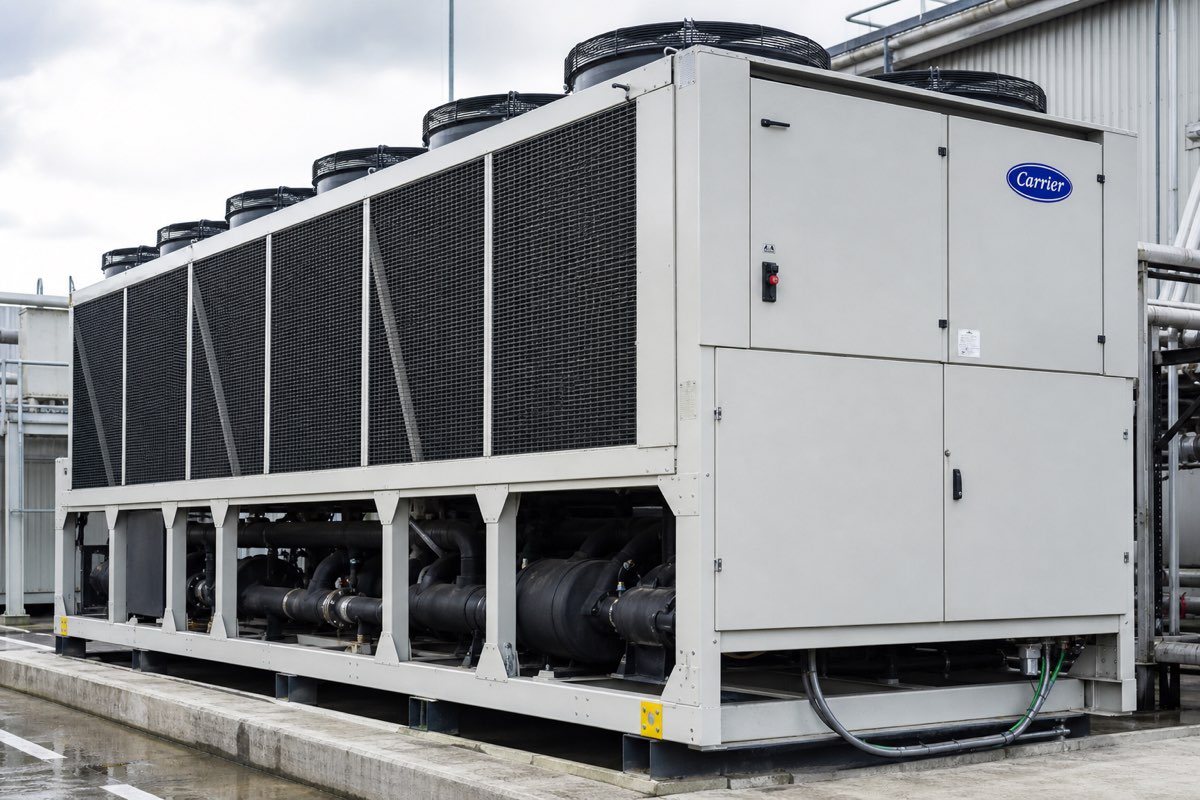
Air cooled chiller rental
When a building or process needs temporary cooling without the complication of a cooling tower, an air cooled chiller is usually the fastest path to chilled water. We route air cooled chiller rental requests to vetted providers carrying self-contained units from roughly 20 to 500+ tons that reject heat straight to ambient air, so most installs are a single drop with power and chilled water connections rather than a multi-piece system.
By Industrial Rental Co Editorial Team Reviewed July 2026
- Self-contained units, no cooling tower or condenser water loop
- Roughly 20 to 500+ tons for outdoor and rooftop placement
- Single-drop deployment with power and chilled water hookups
- Sourced from insurance-verified third-party providers
How an air cooled chiller is sized and placed
Air cooled rentals are sized by cooling capacity in tons at your required chilled water supply temperature, where one ton equals 12,000 BTU per hour of heat removal. Because the unit rejects heat to the surrounding air through an integral condenser coil, there is no cooling tower, no condenser water pumps, and no makeup water to arrange. That simplicity is the main reason facilities reach for air cooled units when they need chilled water online quickly.
Placement still matters. These units want open space with unobstructed airflow across the condenser coil, which is why they typically sit outdoors at grade or on a rooftop with structural and rigging review. Sharing your available footprint, clearances, and the distance back to the load up front helps providers match a unit that physically fits and performs where you intend to set it.
- Capacity quoted in tons at your target chilled water supply temperature
- No condenser water loop, cooling tower, or makeup water required
- Outdoor grade or rooftop placement with clear airflow around the coil
- Pumps, chilled water hose, and distribution often part of the package
Why ambient temperature changes the rating
An air cooled chiller leans on outside air to shed heat, so its usable capacity falls as ambient temperature climbs. A unit rated at a moderate design day can deliver noticeably less cooling during a heat wave, exactly when many facilities need it most. Experienced providers account for this by derating to your site conditions rather than quoting the nameplate number, which is why your location and the time of year belong in the request.
Discharge air and recirculation are the other hot-weather traps. If hot air leaving the condenser is allowed to loop back into the intake, the unit effectively cools itself with its own exhaust and capacity drops further. Providers who place these units regularly plan clearances, orientation, and spacing so the chiller breathes properly even on the worst afternoon of the season.
Common applications for rental air cooled chillers
The most common case is comfort cooling backup, where a building chiller is down for service or a central plant cannot keep up during peak season, and a temporary air cooled unit holds space and tenant comfort. Process cooling is the next, covering loads like injection molding, plating lines, and other equipment that needs a steady chilled water supply regardless of what the building HVAC is doing.
Data center and critical-load bridges are a growing reason to rent. When a permanent cooling system is being commissioned, repaired, or expanded, an air cooled chiller can carry the heat load as an interim measure. Because availability, freight, and rigging vary by region, requests route to multiple qualified providers, and response times vary by location and provider availability.
- Comfort cooling backup during chiller service or peak demand
- Process cooling for molding, plating, and other equipment loads
- Data center and critical-load bridges during repair or commissioning
- Temporary capacity for events, fit-outs, and seasonal swings
Common questions
What is an air cooled chiller rental and how does it differ from water cooled?
An air cooled chiller is a self-contained unit that rejects heat directly to the surrounding air through an integral condenser coil, so it needs no cooling tower, condenser water loop, or makeup water. A water cooled chiller instead sends heat to a cooling tower through a condenser water circuit, which adds efficiency at the cost of more equipment and setup. Air cooled units are usually faster to deploy because they arrive as one piece. That single-drop simplicity is why they dominate temporary and emergency cooling.
How big are rental air cooled chillers?
Providers commonly carry units from roughly 20 tons up to 500 tons or more, and larger loads are handled by paralleling several chillers together. Sizing is driven by your cooling load in tons and the chilled water supply temperature you need to hold. A clear load figure, or even the equipment and square footage being cooled, helps providers match a unit that fits. Sharing your target supply temperature avoids under- or over-sizing the match.
Does outdoor temperature affect how much cooling I get?
Yes. Because the unit rejects heat to ambient air, its usable capacity drops as the outdoor temperature rises, so a chiller can deliver less on a hot afternoon than its nameplate suggests. Good providers derate to your actual site and season rather than quoting peak laboratory numbers. They also plan placement so hot discharge air does not recirculate into the intake. Including your location and timing in the request leads to a more honest match.
Where does a rental air cooled chiller get installed?
These units are designed for outdoor placement at grade or on a rooftop, where the condenser coil has open, unobstructed airflow. Rooftop installs add structural loading and rigging considerations that a provider will review before mobilizing. You will also need a chilled water path back to the load and electrical power sized to the unit. Sharing your footprint, clearances, and power availability up front makes the placement match much smoother.
How fast can an air cooled chiller rental be on site?
It depends on unit size, freight distance, rigging needs, and provider availability, so there is no fixed window. Smaller units near a stocked yard mobilize faster than large units that require cranes or permits. Because timing varies by region, requests are routed to multiple qualified providers rather than promised against a guaranteed time. Response times vary by location and provider availability. Starting the request early always widens your selection and improves pricing.
What needs to be ready on site for an air cooled chiller?
You generally need a stable, level placement area with clear airflow, electrical power sized to the unit, and a chilled water path of hose or pipe back to your load. Many rentals include pumps and distribution hose, but confirming that in the request avoids surprises. For rooftop or tight urban sites, rigging and access planning matter as much as the chiller itself. Providers who work your region regularly fold permits and tie-ins into the scope.
Get matched with air cooled chiller providers
Your specs go on file with us, and we run the search for you, free of charge. Because we don't own the equipment, the match is about your needs, not our inventory. Response times vary by location and provider availability.