
Patient care can't pause.We make the rental happen. You run the hospital.
We know what this day looks like. A boiler or chiller drops, or a survey's bearing down, and the hospital can't pause while you chase down help. The hard truth: without existing relationships, you're a cold call at the back of the line. We're the relationships. We build your facility profile, then put it in front of vetted providers who've done hospital work, and we push for your facility to be treated as a priority.
Free for the buyer. Response and mobilization times vary by provider and location.
By Industrial Rental Co Editorial Team Reviewed July 2026
Vendor network vetted for hospitals & health systems
When the building's utilities falter, patient care cannot wait
A hospital is one of the most utility-dependent buildings your community runs. Steam sterilizes instruments and feeds the autoclaves, the humidifiers, and the hot water taps. Chilled water, the cold water loop that holds spaces at temperature, keeps operating rooms, imaging suites, pharmacy storage, and data closets inside tight limits. When any of that slips, the problem is clinical, not just mechanical, and infection-control and accreditation risk climbs by the hour. That is why facilities teams move on temporary equipment the moment a main system is at risk.
This is where we come in, and honestly, where relationships decide everything. We know what you're up against, so you send one request and we run the search for you. We go to a vetted network of providers we've built real relationships with, the ones who own and operate the trailer- and skid-mounted units hospitals actually use, and we push for your facility to be treated as a priority instead of a cold call at the back of the line. You're not juggling a list of strangers, and you're not doing it alone. Timing varies by location and availability, so the earlier your request reaches us, the more good options we can put in front of you.
- Sterilizing, autoclaves, and humidity control all ride on steady steam
- Operating rooms, MRI and CT suites, pharmacy, and server rooms need stable cooling
- Backup and emergency power come with strict load and runtime rules
- Infection-control isolation shapes where any unit can actually go
Size for backup, document for the survey, and sort out site access early
A hospital rental is rarely one unit dropped in a parking lot. Survey timelines, accreditation standards, and life-safety codes like NFPA 110 (the rules for backup power) all push toward redundancy, so a good plan usually pairs your main capacity with a backup. Joint Commission survey windows add pressure of their own, because a temporary system has to both perform and be documented while inspectors are walking the building. Naming the exact load you have to protect, and the window you have to cover, lets providers scope something that holds up under scrutiny.
Experienced hospital providers carry those code, certification, and documentation duties as part of their scope. They know which records your utility-systems standards expect, they plan around infection-control isolation, and they work the access challenges that make hospital sites demanding: tight loading docks, occupied hallways, rooftop placement, and rigging near patient areas. We make sure you reach providers equipped for all of it, and the more you share up front about fuel, electrical capacity, tie-in points, and access limits, the more realistic your quotes and timelines will be.
- Build in backup so accreditation and survey timelines hold
- Flag the NFPA 110 and life-safety power rules providers must meet
- List the documentation a hospital survey will expect
- Describe dock, hallway, rooftop, and rigging constraints up front
One request, matched to providers who have done hospital work before
Here's the choice, plainly. You can juggle a handful of yards you've never worked with, hoping one has the right unit, available, close, on the day you need it, with no relationship and no reason to put you first. Or you come in through us. We've already done the vetting and built the relationships, so one organized request reaches several providers who know hospital work, and we go to bat for your facility while they quote against your real load and constraints. That's the gap between having things in order in an emergency and leaving them to chance, and when a sterilizer or a chiller is already down, that gap is everything.
Accuracy is what makes it fast. The closest, quickest match happens when your request spells out the system you need to protect, the steam flow and pressure or the cooling tonnage you need, the fuel and electrical available at the curb, the term you expect, and any survey or isolation requirements. Every provider in the match carries their own code compliance, certifications, and permits as part of their scope. Our job is to put your request in front of the right ones, advocate for your facility, and stay with you through the process.
- Say what you're protecting: sterilizing steam, operating-room cooling, or emergency power
- Give flow and pressure, or cooling tonnage, plus fuel and electrical on site
- Note the expected term and any survey, isolation, or access needs
- Several qualified providers respond, so you compare instead of wait
When hospitals call us in
Your steam plant fails during a survey window
Steam quietly runs half the building: sterilizing instruments, the autoclaves, humidity, and the hot water, what engineers call domestic hot water (DHW). When it drops mid-survey, the clock starts and the stakes are real. This is where relationships earn their keep. We go straight to providers we already know, some of whom stage mobile steam units near major industrial areas, and we work to get you covered before a bad day turns into a worse one. A mobile steam unit at hospital scale is a known rental cost, typically four to five figures a month, small against a failed survey window or a sterilization line that has to stop.
A chiller goes down in a heat wave
Lose a chiller in the heat and the dominoes fall fast. Chilled water, the cold water loop that holds your spaces at temperature, is what keeps operating rooms, MRI and CT suites, the pharmacy, and the server rooms in range. You don't have time to audition strangers. We tap providers we've already vetted who carry air-cooled and water-cooled units in the 100 to 2,000 ton range, and we push hard on your behalf.
A planned shutdown for boiler retubing or a chiller overhaul
When the outage is on your calendar, the win is walking in with it already handled. For a boiler retube or a chiller overhaul, we line up providers we trust to cover the full shutdown window and build in backup, so your survey and accreditation timelines hold and nothing's left to chance.
You need backup power beyond what's on site
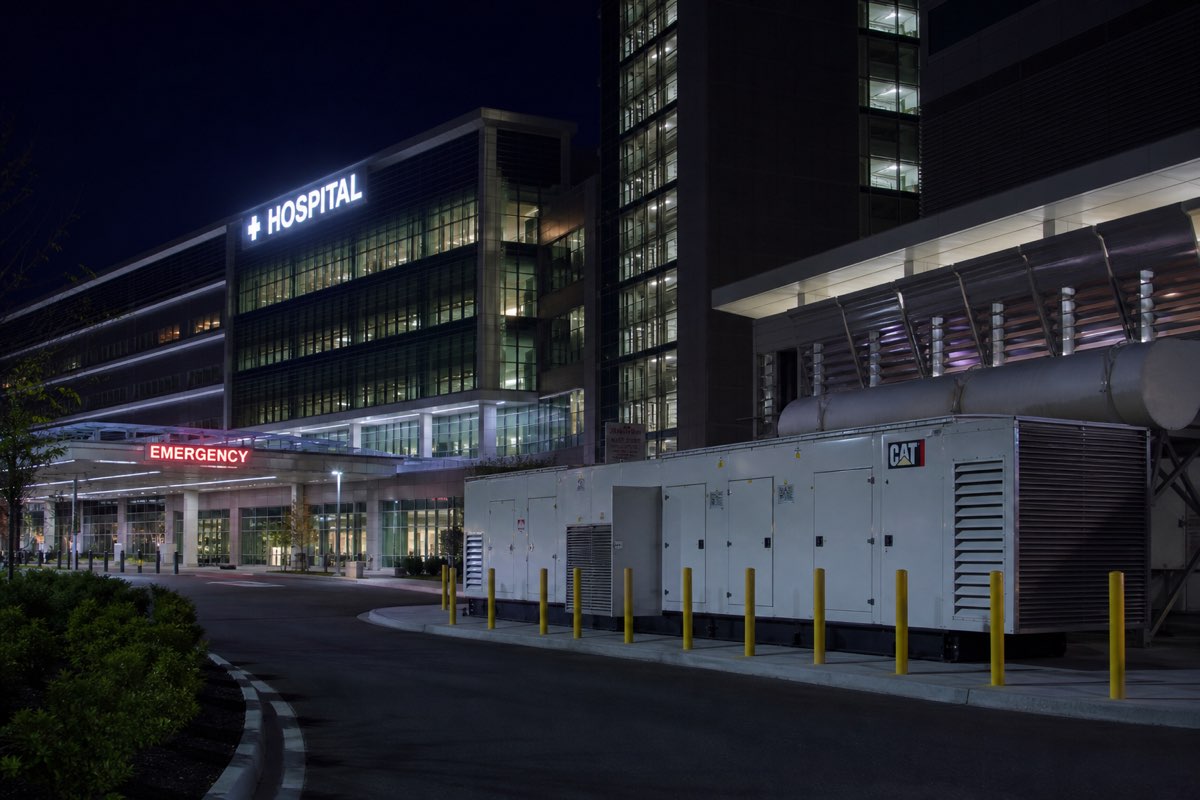
Hospitals run under strict backup-power rules, the life-safety code known as NFPA 110, with firm limits on load and runtime. When the gap opens during an outage, a fuel switch, or paralleling work (tying generators together to share the load), you want people who already know who to call. That's us. We coordinate temporary generators through providers we have relationships with, and we move quickly.
Hospitals & health systems rentalquestions
Every utility your facility runs on,sourced under one intake.
One spec submission covers boilers, chillers, cooling towers, compressors, and generators. Vendors are matched per vertical to the providers carrying the right equipment for hospitals & health systems.
Find providers in your state
We route requests across all 50 states. These are the deep-network states where our vetted provider coverage runs deepest. Response times vary by location and provider availability.
Get matched for hospitals & health systems
One intake. Vetted providers. Response times vary by availability.